The point: Isaiah Armstrong did not even make a passing attempt properly preparing the ground for concrete, and made an almost unbelievable excuse for his failure to do so.
Grounds Were Not Properly Demolished for Preparation
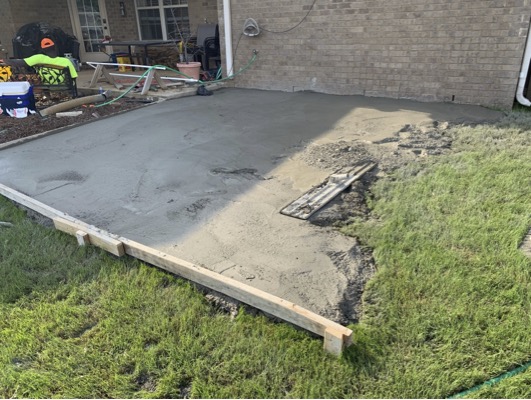
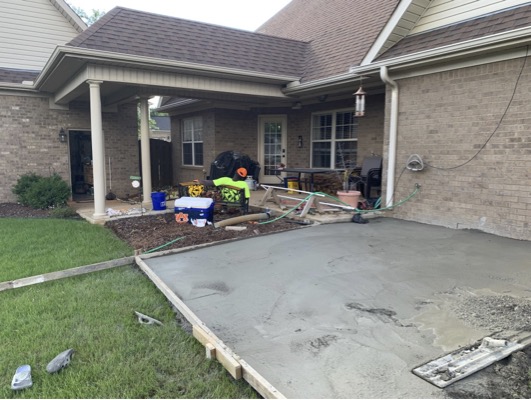

When I confronted Isaiah Armstrong about his failure to properly prepare the ground for concrete, Isaiah Armstrong stated that “demo existing grounds for preparation” was limited to removing a piece of metal landscape edging and moving some mulch out of the way.:
"No, man. That meant moving this edging and mulch out of the way."
This is a totally unacceptable and extremely unprofessional answer. No reasonable person operating in the context of a construction project would conclude that a contract line stating “demo existing grounds for preparation” was limited to removing garden edging and mulch. Any reasonable person would conclude that it means exactly what it says: demo existing grounds for preparation. And, anyone even remotely versed in the process of properly pouring concrete – as I am – would conclude that this meant to prepare the ground to accept concrete as stated above and as part of what are considered industry standard practices.
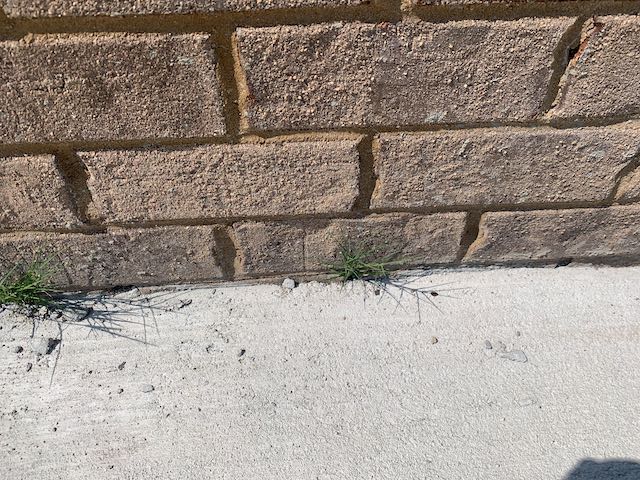
Because this slab was poured directly over grass, the grass will decompose over time after the concrete has hardened, leaving voids beneath and within the concrete. This will cause uneven settling and eventual cracking and breaking. Additionally, water will be able to enter areas where the grass has decomposed, and, with repeated freeze and thaw cycles that are possible in the winter in Madison, this will lead to further cracking and further breaking. Without maintenance, any grass regrowth in existing cracks will lead to even further cracking until ultimately this slab is nothing but a pile of gravel.
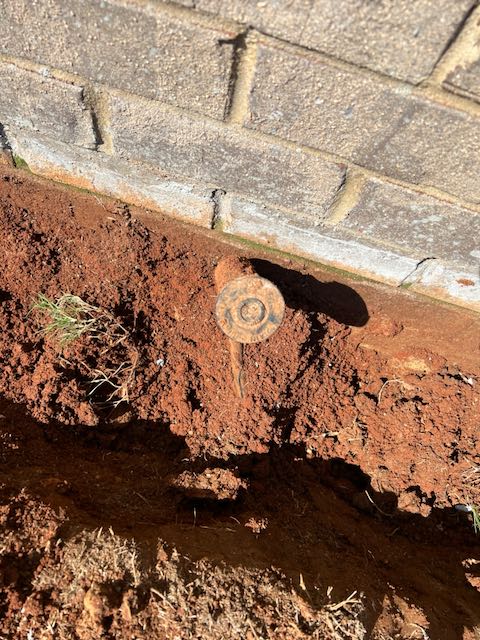
Additionally, during demolition of Isaiah Armstrong’s “work” it was discovered that he had buried a sprinkler head. I warned Isaiah Armstrong during our initial consultation on May 4, 2021 that there was an irrigation system on the property and that there was an irrigation head in that area that would likely need to be removed. I indicated that it would be fine to just cap it off at the pipe, under the belief that Isaiah Armstrong would be doing proper site preparation work that would involve excavation. I even marked, using red flags, the sprinkler heads that were in the vicinity of the slabs. These were ignored.
Had I turned the irrigation system on, further water damage would have occurred underneath the slab, leading eventually to voids forming, cracking and disintegration.
There are reasons points like site preparation, proper grading and drainage, compacted subgrades, gravel subbases and sand layers are considered industry standard practices: because this is what it takes to make a concrete slab that lasts more than a few years. A properly poured slab will last decades or longer if standard practices are followed. But one poured on a bad foundation will inevitably fail within a matter of months or years.
The process for successfully pouring lasting concrete has been known since the Roman times. Is well understood by trade professionals and even well-versed amateurs who have done basic research. It is not necessary to explain, in detail in a contract, how a tradesperson is expected to complete tasks that involve industry standard practices and simply part of doing proper work.
In the same manner that you would not specify in a plumbing contract the method the plumber must use to properly sweat a pipe, as any reasonable person would conclude that they would do so properly as a matter of good tradesmanship, it is not necessary to specify in the contract all the procedures that would be necessary to successfully pour a concrete slab. It should be done so properly as a matter of good tradesmanship.
It should not be necessary for me to explain to Isaiah Armstrong, who advertised himself as an experienced professional, why firm foundation is crucial in pouring a slab and that following these industry standard practices is important.
And yet, here we are.